We live in a male dominated world. Since the creation of these two nations, men have ruled with an iron fist when it came to laws and politics. Despite women not having suffrage, they helped shape these nations education as well as boldly redefining their own rights.
Republican Motherhood
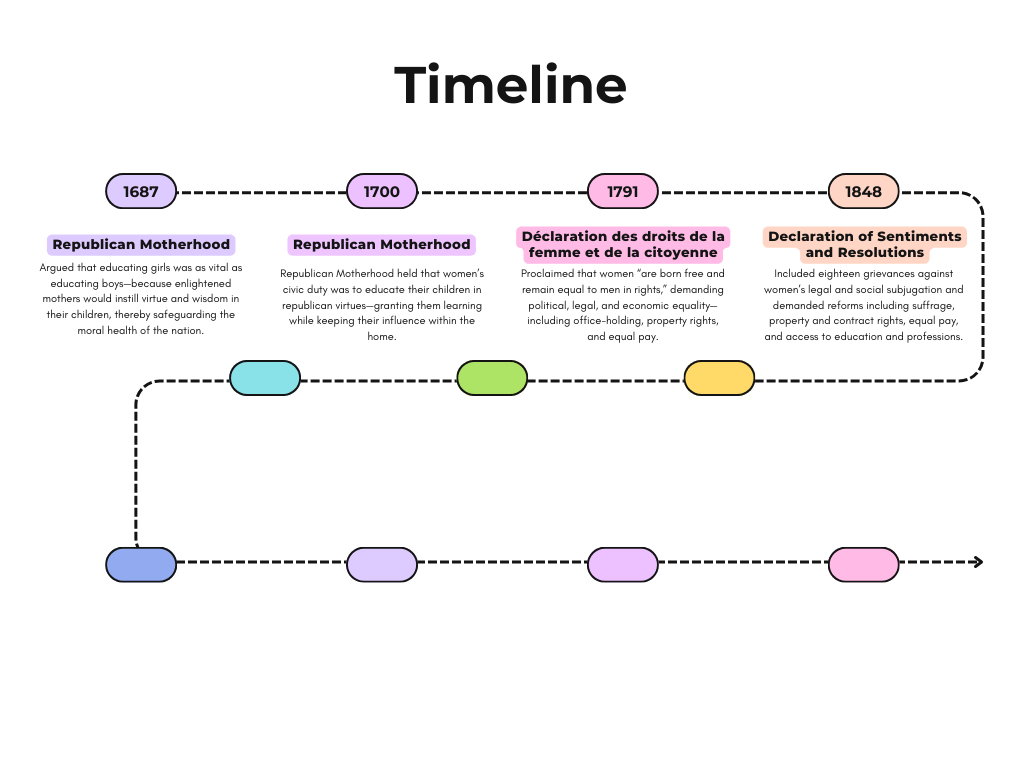
A popular idea in early American homes was Republican Motherhood. Republican Motherhood arose as a way for women to gain education and knowledge, emphasizing the critical role that mothers played in shaping the future of the nation. The ideology supported women gaining an education because once women became mothers, they were in charge of teaching their sons who would then become the leaders of their nation. As a result, educated women were viewed as essential to nurturing informed, principled citizens who would contribute positively to the young republic.
Traité de l’éducation des filles
A similar idea made its way around France in the 17th century, with the publication of Fénelon’s “Traité de l’éducation des filles”. This influential work emphasized that women should be educated primarily to support their sons, nurturing them to become exemplary citizens and leaders of society. While this concept was regarded as remarkably liberal and controversial at the time, it played a crucial role in introducing ideas of women’s education into a predominantly religious and patriarchal society. The discussions prompted by Fénelon’s treatise opened the door to a broader acknowledgment of women’s potential beyond domestic roles.
Le Déclaration des droits de la femme et de la citoyenne
Now, what did women do to advocate for equality? In France, Olympe de Gouges published Le Déclaration des droits de la femme et de la citoyenne (Declaration of the Rights of Woman and the Female Citizen). This came in direct response to Marquis de La Fayette’s Déclaration des droits de l’homme et du citoyen (Le Déclaration des droits de la femme et de la citoyenne (Declaration of the Rights of Man and the Male Citizens). In the declaration De Gouges highlights important points like in Article 1: Woman is born free and equal to man in rights”, Article 2: “the preservation of the natural and imperceptible rights of woman and man”, and Article 9 where she calls for equal right to property after divorce and consensual marriages (not arranged).
Declaration of Sentiments and Resolutions
Women in the USA published something vary similar but in the mid 1800s. During the first women’s rights convention, The Seneca Falls Convention. Here, a group of women and men wrote and published the Declaration of Sentiments and Resolutions. This declaration was closely modeled after Thomas Jefferson’s Declaration of Independence. There were two different sections to this, the grievances and the resolutions. The grievances consist of 18 different ways men have made women feel or be inferior, “he has never permitted her to exercise her inalienable right to the elective franchise.”, “he has compelled her to submit to laws, in the formation of which she had no voice.”, and “he has taken from her all right in property, even to the wages she earns.” Their resolutions consisted of 12 ways to promote equality including right to vote, equal pay, sample social privileges, and right to enter into contracts and initiate divorce.
Conclusion
Across these texts and ideas, we are able to draw connections on ideas of feminism and equality. While these nations happened to be an ocean away, the concepts and discussions they inspired were remarkably similar. Women around the world, no matter where they lived, desired equality in all aspects of life, from the social and political arenas to economic independence. This universal longing for justice and recognition was not just a distant echo; it reverberated through time and across cultures, igniting movements that would challenge oppressive norms. A variation of this would soon come in the following centuries, as the foundation laid by early advocates would evolve into more organized movements, addressing the complexities of intersectionality, and bringing forth a more nuanced understanding of what true equality entailed in varying contexts.

 Liberté vs Liberty
Leave a comment