As the 1900s progressed, the need for equality and a life full of satisfaction drove women to fight harder than ever for a new life they had never thought imaginable. Ideas of feminism were spreading faster than ever with the help of books and laws.
The Feminine Mystique
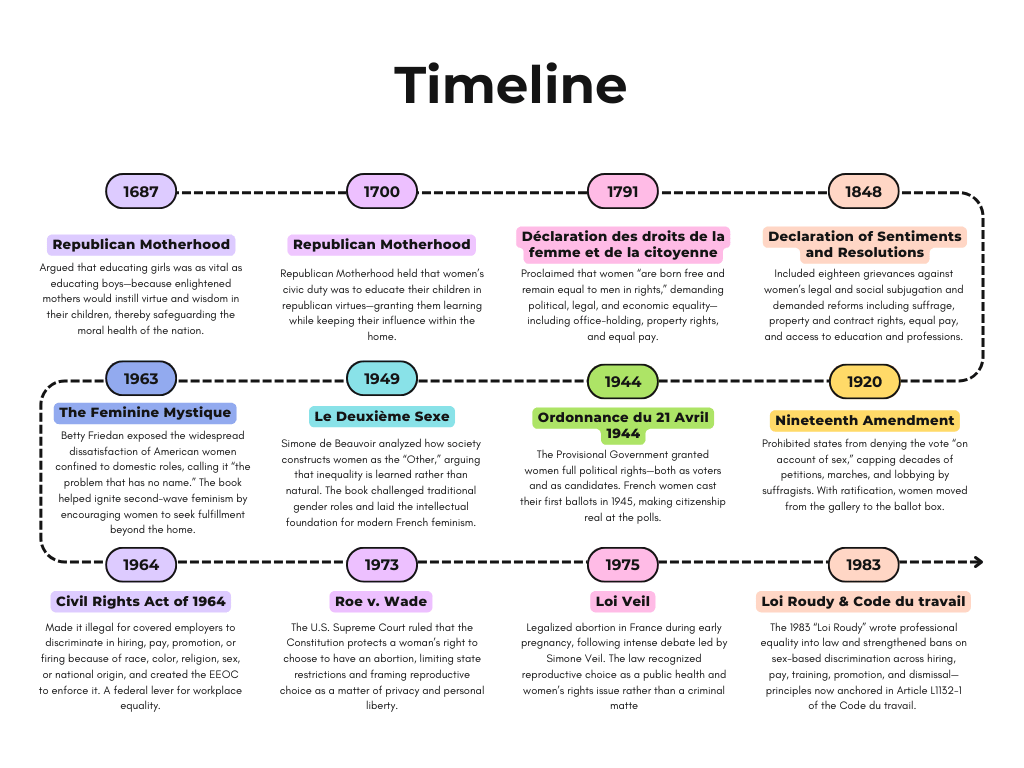
By the early 1960s, many American women were experiencing a deep sense of dissatisfaction despite living lives that society labeled as “successful.” In 1963, Betty Friedan published The Feminine Mystique, a groundbreaking work that challenged the belief that women could find fulfillment solely through marriage, motherhood, and domestic life. Friedan famously described “the problem that has no name,” capturing the frustration of women who felt intellectually and personally unfulfilled while confined to the home.
The book became a catalyst for second-wave feminism in the United States. Unlike earlier movements that focused primarily on legal rights such as suffrage, The Feminine Mystique addressed social, psychological, and economic inequality. It questioned rigid gender roles and encouraged women to seek higher education, careers, and personal autonomy. Its impact extended beyond literature, inspiring activism and helping to spark broader conversations about women’s roles in society.
Le Deuxième Sexe
France experienced a comparable intellectual awakening more than a decade earlier. In 1949, Simone de Beauvoir published Le Deuxième Sexe, a philosophical and social analysis of women’s oppression. De Beauvoir argued that women were not born inferior but were made so by cultural and social structures, famously stating that “one is not born, but rather becomes, a woman.”
While Le Deuxième Sexe was controversial and even condemned upon release, it fundamentally reshaped feminist thought in France and beyond. Like Friedan’s work, it rejected traditional expectations placed on women and emphasized autonomy, identity, and lived experience. Both texts marked a shift from legal arguments toward deeper critiques of societal norms, laying intellectual foundations for future feminist activism.
Roe v. Wade (1973)
As feminist ideas gained traction, demands for bodily autonomy followed. In 1973, the U.S. Supreme Court issued its ruling in Roe v. Wade, recognizing a woman’s constitutional right to choose to have an abortion under the right to privacy. This landmark decision limited the ability of states to regulate abortion, particularly during the early stages of pregnancy.
Roe v. Wade represented a major victory for the women’s rights movement, affirming that reproductive decisions belonged to women rather than the government. The ruling reframed abortion not only as a medical issue, but as a matter of personal liberty and equality. For decades, it stood as a cornerstone of reproductive rights in the United States.
Loi Veil (1975)
France reached a similar milestone shortly after. In 1975, the French government passed the Loi Veil, named after Minister of Health Simone Veil. This law legalized abortion during the early weeks of pregnancy, following intense parliamentary debate and public opposition. Veil’s speech before the National Assembly emphasized compassion, public health, and women’s dignity.
The Loi Veil marked a turning point in French reproductive rights, recognizing abortion as a social reality rather than a moral failing. Like Roe v. Wade, it affirmed women’s autonomy over their own bodies and signaled a broader acceptance of gender equality within the legal system.
Conclusion
Together, these developments reveal another clear parallel in the progression of women’s rights on both sides of the Atlantic. Foundational feminist texts, The Feminine Mystique in the United States and Le Deuxième Sexe in France, challenged deeply ingrained social norms and reshaped how women understood themselves and their place in society. These intellectual shifts paved the way for concrete legal changes, most notably the legalization of abortion through Roe v. Wade in 1973 and the Loi Veil in 1975.
While the specific political and cultural contexts differed, the trajectory remained strikingly similar: ideas sparked awareness, awareness fueled activism, and activism led to rights. Together, these moments illustrate how women’s struggles for autonomy evolved from questioning societal expectations to demanding and securing control over their own lives.

 Liberté vs Liberty
Leave a comment